
Do Higher Taxes Equal Greater Happiness?
While sitting in my backyard on an early Saturday morning reading the news, I came across another one of those silly happiest countries on earth reports. I find them silly anyway. Trying to determine an entire country’s happiness and then ranking them against one another seems to be a waste of time at first glance. But the silliness and the thought of hundreds, maybe thousands of hours spent making this report piqued my interest, and so I decided to dig deeper into this list of so-called happy countries and see how exactly this is determined…and why a specific region seems to have a monopoly as the top ranked. A region with obscenely high taxes. Could it be that higher taxes equal greater happiness?
Much of what I read and listen to in the FIRE-sphere has to do with happiness. I can see why. There are only two reasons why one would choose to go down the not-so-easy FIRE path; you are either currently unhappy and being financially independent will somehow make you happy. Or, you are happy, but being financially independent will make you happier.
Either way, happiness is the goal of FIRE. There might be a thing or two to learn from why these countries are so happy and why paying more taxes to their government may play a role in this.
world happiness report
Surprise, the Scandinavian countries top the world happiness list. Those countries tucked just under the arctic circle continually rank highest on this list. How is that? Isn’t it dreary and cold most of the year in those parts with winters terribly long and arduous? Aren’t the taxes some of the highest in the world in those countries? How could these two factors alone allow a place to rank year after year as one of the happiest countries/regions on the entire planet?
The UN is the responsible party for publishing this yearly report called the World Happiness Report. It’s based on a Gallup World Poll survey of 1,000 people from each country. It’s based on real GDP per capita, social support, life expectancy, the perception of an individual’s freedom, corruption, and neighbors.
Here’s the top 10. You can read the most recent report here. It’s interesting and academically in depth.


The UN and the academics who put this together use a series of factors for its rankings. Seems most of the factors have to do with money. From asking people how likely they think their wallet will be returned by a neighbor, to using mathematical formulas to calculate a country’s income inequality. It turns out that a country’s income inequality plays a huge role in a society’s happiness. Being a personal finance nerd, this wealth equality factor caught my eye.
Equality. Such a powerful yet contentious word. In the US, from solely a financial perspective, wealth equality can ring antithetical to the whole capitalist American thing. For most of the twentieth century, the United States was engaged in a bitter and expensive Cold War against the ideology of state-sponsored “wealth equality” aka communism. We all know who won that war of ideology, and for good reason. One cannot escape the power and allure of the free market and private capital, not even the Soviets.
Yet, for the US being one of the richest countries in the world, its high wealth and power propelled by capitalistic income inequality, why does the US rank 14th on the list of happy countries? We’ve actually never ranked in the top ten since the creation of this list.
The United States has better weather (well, I do here in California) and lower taxes than the top ten on that list. Our passport is one of the most powerful in the world. I would think that would be a cocktail for happiness…at least top ten happiness, right?
higher taxes = greater happiness?
Look at how much these happy residents of Scandinavia pay in taxes! Really makes me wonder if paying higher taxes equals greater happiness.

How can these Nordic countries be the happiest places to live when half your money is taxed away? You’d give up nearly half your income in the top 8 happiest countries in the world. I mean, here in the United States, the richest only pay 37% in income federally, and you’d have to take home more than $622K (married filing jointly) annually to pay that, even our progressive tax tier means that only a portion is taxed that high.
And look at those capital gains taxes in Europe and especially Scandinavia. In the United States we pay a long term capital gains rate of 15% for an income of $80K-$496K.

There’s one list the US does seem to continually top. And that’s wealth per adult. Credit Suisse published this list of the top per capita wealth by countries in the world. The United States is number 2.

Americans have the most money in the world and pay fewer taxes on it. Keeping your money for yourself should make you happy? Maybe its not about having more money.
In fact, if you want to disregard the UN Happiness Report, you can’t believe that Americans consume the vast majority of the world’s pharmaceuticals because we are secretly the happiest country. Could it be that having and making more money might lead to more stress? More uncontentedness?
Is it less stressful to know that your health coverage isn’t dependent on your employer? I would imagine. Most of these top-ranked countries have free tuition for universities. Free childcare. And very high minimum wages. The Scandinavians also feel inclined to work less (maybe because they know they’ll pay more taxes on more income?) with the Danish work week consisting of 37 hours and capped by law at 48 hours per week. In Sweden, the average workweek is 35 hours according to Statistica. The Swedes have even provided tax breaks for repairing things like appliances, cars, and bikes, instead of throwing away and buying new…talk about a FIRE like mentality.
The Norwegians and Swedes have a word for this urge not to want and compete for more and more and it’s called logom. The Finnish use sopivasti. Which translates to moderation or just enough. Culturally, it’s the avoidance of extremes and risk. Maybe it’s this common lack of want that drives happiness levels up. This mindset of contentment with things as they are. If there’s no urge for newer and better things, this has to have an effect on the people living in a society like this. It’s the frugal mindset applied to every aspect of life.
wealth equality and happiness
The Gini Index is used by the World Happiness Report to help determine rankings. Guess what? This index also happens to correlate with the “happiest countries” list. Coincidence? Maybe. But maybe, it backs up the equality is happiness theme a bit more. I mean it’s math. Hard to argue against numbers.
The way this income equality formula is determined stems from an Italian statistician named Corrado Gini. He ended up being a bad guy (a fascist) in the second world war, but his coefficient is still widely used today.
Gini came up with a method for analyzing the distribution of wealth in a country. Where 0% on the list formulates to pure equality and 100% is the most unequal.
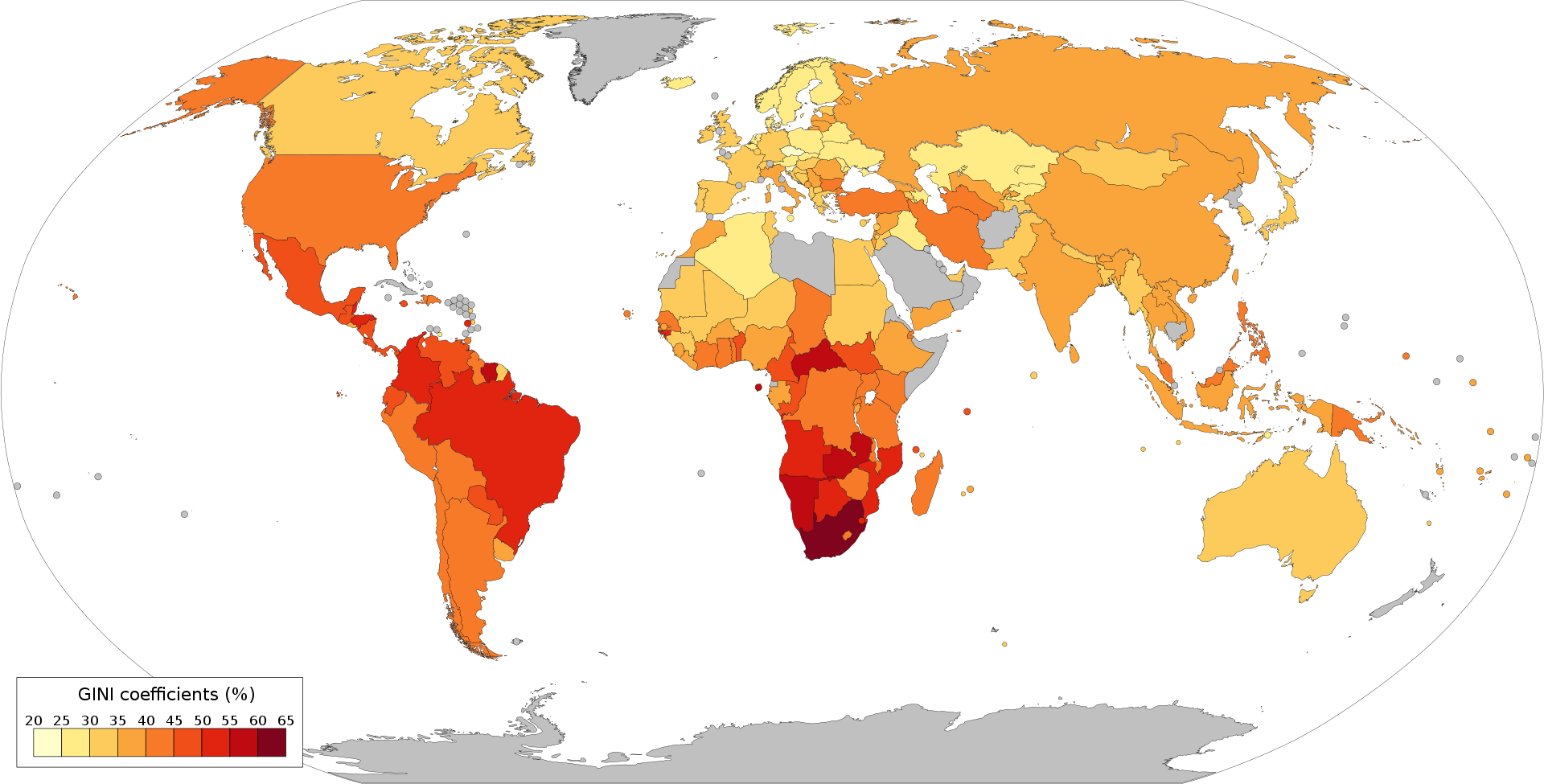
The “happiest countries” have the least amount of income inequality, as you can see above. I have to imagine that knowing you make close to the same amount as your neighbor and the waitress at the restaurant you’re patronizing, or the news reporter on tv, has to take some edge off the rat race razor blade. Not seeing too many people suffering on the streets certainly would be nice too, I know, as I walk the streets of San Francisco daily.
But it’s more than just equal income levels and the shared payment of high taxes that make these egalitarian countries stand out. There’s a cultural aspect of frowning on individuality and exceptionalism. It’s generally looked down upon to brag or boast in the Nordic countries. Something that runs very counter to the American culture I’m used to. I find it fascinating to wonder if this Law of Jante may play into Scandinavia’s general happiness and quality of life rankings…this humbleness that pervades their society.
Jantelagen or The Law of Jante is from a novel written by the Danish born Aksel Sandemose. Jante is a fictional town in the novel A Fugitive Crosses His Tracks. You can read the laws here on Wikipedia. And here’s a better explanation on it from Georgetown University. And another by the BBC. Plenty of writing on this subject. The rules can give an insight into the culture of the region.
The ten rules state:
- You’re not to think you are anything special.
- You’re not to think you are as good as we are.
- You’re not to think you are smarter than we are.
- You’re not to imagine yourself better than we are.
- You’re not to think you know more than we do.
- You’re not to think you are more important than we are.
- You’re not to think you are good at anything.
- You’re not to laugh at us.
- You’re not to think anyone cares about you.
- You’re not to think you can teach us anything.
And let’s be honest, in the FIRE community there’s a little bit of Jantelagen to go around. This could easily apply to how the FIRE pursuers see the outside consumer world…or maybe a FIRE blogger offering a paid course on personal finance. We, with our high savings rates and frugal values (admittedly or not), silently judge those who are making obscenely bad choices when it comes to money. We scoff at consumerism and those people borrowing money for BMW’s and putting Gucci glasses on their credit cards. I can think of a few of the jantelogen rules that might accurately describe someone who’s using money…or even worse, borrowed money, to brag and show off his or her “status”.
rose colored glasses
Okay, let me take off my rose colored glasses now. Nobody, not even the UN, can just broadly make blanket statements about a country and how happy the people who live there are. If there’s one thing that grinds my gears, it’s broad statements about a country, any country. People are too varied and their lives too nuanced to say if you were living in one of these top ranking countries you would be happier. Or that someone living in an unhappy country must be a miserable grump.
They only surveyed 1,000 of us Americans out of a population of 328 million. Might have been a few sour apples in that bunch. And I must admit that my trust in poll accuracy will likely be forever marred by distrust after a few catastrophic polling errors in recent years.
At work sometimes they encourage us to fill out those “Best Places to Work” surveys. Luckily, I do work at a great company, but I can see where things can get off the rails on these surveys. People want to be happy and want to show others their happiness, so they may have the urge to fudge a bit on their answers. What does hold some water for me is the correlation of happy nations to greater wealth equality via the Gini Index.
Another last thing that America probably owns that these Scandinavian golden children of the World Happiness Report don’t, is that it’s probably a hell of a lot easier to hit financial independence in the US than those high tax “happier” countries. We have the ability to keep more of our income to invest. And let’s not forget the fewer capital gains taxes we will pay when it comes time to withdraw our money.
Personally, I’d be willing to pay more taxes for universal health coverage. But man, it would take some time to wrap my head around a 50% tax on my income to pay for it, but if high taxation is the ticket to happiness…that’s a tough pill for an American to accept.
As Americans, we do pay this high tax or cost eventually, maybe not directly to the government, but we pay it. It comes out of our own pocket for health coverage, childcare, and college tuition. At a minimum, we have the advantage of choice, though there’s certainly some stress that might accompany that freedom of choice. Especially for those who don’t have the ability or capacity to make good choices.
So do higher taxes really equal greater happiness?
Maybe it’s not the higher taxes that make these countries so “happy”, but the wealth equality? Scandinavians have less choice on how their money is spent by the government, but sometimes too much choice can leave you feeling dissatisfied and disappointed.
There are more than a few similarities between the Scandinavian cultural use of lagom in those “happy” countries and the undeniable aspects of stoic and eastern philosophy that come with living a frugal life. To FIRE, in the traditional 4% sense, is to be okay with not having everything, and challenging the human desire to want, which in my opinion is key to being happy and content.
Maybe the UN ought to include a few FIRE members in next year’s World Happiness Report survey…that may be the ticket to get the US into the top ten for once, I’m just saying.
What do you think? Does higher taxation equal greater happiness…obviously, this means a bigger government. Is the World Happiness Report just a bunch of BS? Has anybody been to Scandinavia, would love to hear about your experiences? I’ve never been but now I’m itching to see this pricy utopia/dystopia.
Discover more from Happily Disengaged
Subscribe to get the latest posts sent to your email.
23 thoughts on “Do Higher Taxes Equal Greater Happiness?”
having grown up blissfully ignorant in a small rural town i’m glad there weren’t many jones’s to compare to in day to day life. i don’t think i realized we had less than some until i had seen some of the world by my 20’s.
i can see how more equal wages can lead to more happiness. the pressure might be less to make the huge dollar for work you will hate like in the u.s. just pick an vocation you think might suit you instead.
i wonder if there is less regional mobility in some of these high scoring countries. if you move less geographically you might feel a greater sense of community and connection. i prefer to know some community as opposed to all the anonymity among neighbors here.
That must have been a great childhood as far as everyone being on an equal footing. The whole inequality thing didn’t really hit me till I was high school and some kids were rolling up in brand new cars and it was like wow, some people’s parents can afford to buy new cars for their kids? Having grown up a few miles from San Francisco and now working there every day, I really see the disparity. It’s like a 3rd world country out here with the shanty town slums and all and a block away 300 sf studios are going for $3.5k a month.
I can see the equal wage thing being a huge factor in happiness rankings too. What I don’t completely understand is how it’s managed and maintained. You would think eventually things would get out of wack. Yeah, you’re right on, people would pick jobs that made them happy rather than suffer for the dollar. You bring up a good point about the mobility thing. Those countries are really small, both in size like Denmark or population with just a few big cities, I’m sure that must play into it. I have to do some more reading on life over there, it’s really fascinating to my American mind how it all works and keeps working for those countries.
I don’t think it’s necessarily a tax rate that determines a country’s level of happiness. Speaking purely from anecdotal evidence, the happiest people I’ve ever encountered are Colombians, Peruvians, and Dominicans — I mean as in they live there or emigrated to the US a little later in life. And those are not wealthy countries, though there are stark differences in wealth in Colombia and Peru.
As my old Dominican roommate once told me, “I never met a depressed person until I moved to the US.” When I asked her to tell me more, she told me, “No one is depressed because no one has anything. You don’t envy what someone else has because they don’t have anything. And you’re never alone, so you’re not lonely.” She thought Americans spent far too much time lusting after everything else that others have and they spent far too much time alone. My Danish friend found the US very isolating when he attended grad school here — and he came here to make money and eventually left. My Jordanian tour guide also found the US lonely and isolating when he lived here. And most adults find it difficult to make friends, even though they want friends. I know I’ve struggled with that and have met countless others who’ve experienced the same. We’re often too busy to meet people and maintain friendships.
While I believe that economics and income disparity play a role in some of our unhappiness, I believe it goes far deeper than that. I think much of it revolves around working long hours, having fewer vacation days, and not focusing enough on spending quality time with family, friends, or a community. Research shows how deadly loneliness is. No amount of money can cure it. And if Colombians are the happiest, most welcoming people I’ve ever met then that says something too after all they’ve endured. Colombians sure know how to celebrate and have fun! Mostly, their attitude is to not let things bother them and to let everything bad go.
Of course, the fewer things you have to worry about, the better. There are things I love about other countries and there I things I’m glad we don’t have (super high taxes!). But I’ve also lived overseas and know it’s not perfect either. No place is. And there’s always room for improvement. Nice topic!!
Great perspective and you bring to light something I have also experienced in Latin American and SE Asia, but hadn’t thought to think about for this post. The people in those countries really are happy and nice! I can remember quite a few times people going out of their way, even spending hours with me to help me find my way in those countries. They showed kindness to a complete stranger that I don’t think I’ll ever find in the Bay Area. I’ve never been to Scandinavia, but I have experienced the coldness of the richer countries, Europe for example…which is similar to the US in how I feel talking to strangers. But Latin America, people just want to greet you and welcome you. People just congregate in the street to hang out with each other, it’s very nice to experience. Appreciate you bringing this up.
You make me wonder why those poorer countries aren’t higher ranking on the happiness index. From what I read, the UN takes high regard to services the government provides, and of course, wealth. Maybe the list shouldn’t be called the World Happiness Report, but World Comfort Report haha. Those in richer countries are just more comfortable, which doesn’t directly relate to happiness. In fact, you could say comfort hinders the ability to grow and break free of things causing unhappiness.
Spot on about loneliness being a major factor for unhappiness and stifling longevity. I’ve read and watched documentaries about this subject of people who live in Blue Zones. Community is number one. I also struggle to make friends at my age and I’ve seen my friend list dwindle down over the years. Sometimes I look back at my 20’s self with dozens of friends and I’m like who was that person? You bring up a good point that it’s just not that important to me to maintain or try to get new friends, as work takes up so much time. But if work were removed, I’m sure I would feel it. I can imagine how older folks feel impacted by this when they retire at a traditional age. I’m a big believer in the fewer things we have, the less we have to worry about, for me, less choice also falls into this category.
Thanks for the thoughtful comment. You made me rethink the subject, whereas I was focused on the wealth and data aspect and not so much on my own travel experiences between rich and poor countries.
I’ve been reading and thinking about this topic for a number of years now, and I’m glad you brought it up. I think many of the points you hit on, about wealth equality and social programs definitely have an impact on the level of happiness a country experiences, however you define that. I also think everything Katie said in her reply is pertinent, about social connectedness and not feeling lonely. This is made pretty clear in the World Happiness Report as well.
Here’s my anecdotal take. I’ve visited western Europe at least 20 times and probably spent 8-9 months of my life there over the course of my work. I’ve also spent a solid chunk of this time in Sweden and Denmark. To my mind, the people in these countries are more relaxed, less stressed, and less concerned about their fate. Why? Because they’re not ground down by stressful, demanding jobs that threaten to fire them without notice or justification. And losing their job doesn’t immediately lead to loss of income and health insurance, which can imperil Americans and potentially lead to homelessness in a matter of weeks. America is a country of high risk and high reward. Most of these Europeans from “happy” countries don’t have to worry that an economic recession or an anomalous blood test could lead to financial ruin and essentially destroy their lives. We, as Americans, face that kind of risk every day. We will never have the kind of security (safety net) that these nations enjoy, and I think it’s a major drag to our overall happiness.
What is FI? It’s personally insuring against worst-case scenarios. It’s providing your own safety net, so you can be assured that things will be OK regardless of what life throws at us. That’s why FI is synonymous with happiness in our culture, in my opinion. Great, thought-provoking article Noel. And sorry for not even mentioning tax rates, haha. I think they’re the price one pays for peace of mind, in some regard.
I’ve thought about this for a while as well. It’s a fascinating mystery to me, as I’ve only lived in the United States. The older I get, the more I think about the large social safety net cast out by these governments as maybe not a bad thing for society, but then again look at the size of these countries. They’re much smaller and homogeneous, and this probably makes them much easier to govern. I agree that this takes much stress out of the lives of people who are “covered” just by being a citizen and not an employee. That’s probably the starkest difference for me: the employee vs citizen benefits.
What great points you bring up! I’ve never been to Scandinavia and appreciate you sharing your experience. I can attest to the laid-back no hurry atmosphere of Europe from my travels. It makes me wonder if there’s any correlation between this attitude and the slower economic growth of Europe over the last few decades–which I’m not saying is a bad thing–they’re mature economies after all. I just wonder if productivity and entrepreneurship ultimately suffer from it. You state it correctly that the drag on happiness probably has much to do with the potential ruin we face by privatized health care and the dependence on an employer. Great comment. Appreciate you stopping by.
The comment about country size and homogeneity is a great point. Notice I didn’t say that the US could impose the same social policies of these nations. In fact, I don’t think they could. I hope we trend toward a basic support system, so that people have something to fall back on, but it’s unlikely we’ll ever achieve the level of support we see in the Nordic lands.
I would agree that Europe has slower economic growth than the US for the reasons we’re talking about. But honestly, why does GDP matter? Think about it. It’s a number that represents per capita output. It has nothing to do with wellbeing, prosperity, or anything. If one person in the US started a company that had a monopoly on something, and earned 10 trillion a year, our GDP would be much greater, but what would that do for you and me? Nothing. We’d get to watch that a$$hole fly to the moon every month and try to colonize Mars, all while refusing to offer basic benefits to his employees. Haha, OK I’ll take a break now, I’ve been reading way too much anti-capitalist stuff lately.
Yeah I unfortunately also don’t believe the US will ever have the same sort of social government as the nordic countries. I will keep my fingers crossed for some form of universal healthcare by the time I’m in my 60’s, but I’m not gonna count on it. The smaller the country size, the easier it looks to govern and get what the majority of people want (from an outsider’s perspective). The size of the US certainly makes it difficult to govern.
You’re preaching to the choir. I would say that with higher GDP this would hopefully mean companies are growing and in turn retail investors could benefit. It is a little disconcerting to see the excess on display for these CEO’s and their pet projects while their company’s treat their employees poorly. I have one word for these workers- unionize.
We have been here. Took a trip exploring Sweden and Norway back in 2015. We set ourselves up knowing it would be expensive but we had a great time. Started in Stockholm and worked our way West to Olso then to Bergen. I remember taking the Flam Railway, one of the steepest rail lines, up to the top of a mountain where the station had gluten free snacks. Then taking a ferry through Fjords and tasting fresh ice water dripping off a glacier. We followed a Norway in a Nutshell Tour outline and booked it all ourselves to save some money. From the adventure I don’t remember feeling overwhelmed by the cost. We did a lot of cool things that I will always remember. One thing I do remember is not being a fan of their food and not understanding what we were ordering. We ate a lot of Burger King, their most popular American fast food joint, just because it was familiar and in English.
And I can’t forget the goose that attacked Chris! Those birds don’t like him.
Sounds like you guys had a blast. I’ll have to keep that Flam Railway in mind for our future trip. I love railways and mountains so this sounds like an awesome mix. There looks like tons of hiking and outdoor fun to be had out there. We had a similar experience to what you describe for cost when we went to Japan. Super expensive, but our mindset was right and looking back we never think of the cost, but the fun experiences. I just finished reading a book about the region, then after researching for this post, I’m super pumped to get going to Norway and Sweden for a future trip while we’re still working. It’s funny, prior to kids we were trying to knock out the tougher to travel to countries, now that we’re still working, our agenda is to knock out the high cost countries while income is higher.
Thanks for commenting and sharing your experiences!
I just want you to know, I didn’t do anything to that goose (or other subsequent geese) to deserve being attacked.
Also, great post, as usual, and an interesting take on the relationship between taxes and happiness. Cool!
PS: See the Vasa in Sweden if you can.
Haha I’ve been the victim of a goose attack as well…but at the local lake. Yeah I just read an article about that ship a few weeks ago. Looks amazing. And the decades long process to get it back into a preserved state to be shown is incredible.
Very interesting and thanks ks for the detailed article here. I would tend to agree with the “lack of want” and social cohesion to be the primary driver for happiness. If for no other reason, than they are for my own personal happiness.
Yup. When it’s all boiled down, lack of want is what leads to happiness. This is obviously much easier said than accomplished.
Honestly I suspect this is mostly due to homogeneity of population and also consistent communities. Differences, not just financial, spring conflict. The top ten are all countries with low immigration, fairly similar racial background, similar finances, many of them have wealth sources less concentrated in labor …. You get the point.
You bring up an interesting point, minus Germany of course. I hadn’t thought to think of that. Yes, it’s very tough for immigrants to get to Scandinavia. Another strange observation, is the top 8 countries also came out of WW2 nearly unscathed (Finland had a rough go and forget Germany) I wonder how much this plays into a nation’s psyche over time, not losing a generation and needing to rebuild. I would say what you suggest might lead to a more effective governance–and in turn, more state welfare to create an atmosphere of ease, rather than immigrants causing unhappiness. The lowest ranking countries, the most unhappy, are even more homogenous and have lower immigration rates than the top ten. So I’m not so sure a low immigration population is a driving factor for happiness in a country.
To be clear I didn’t necessarily mean immigration is bad. In fact I wrote a whole piece about the benefits of immigration. I’m more thinking along your lines. Long term stability and simularity drive hapiness. Stated another way, humans hate change and differences drive change. Also differences increase conflict leading to change. I don’t believe the amount of welfare plays into it even. Going to go out on a limb and guess the least happy on the list are countries with serious government stability issues.
You’re right that government stability is key. I can see how less change and disruption to the norm and customary way of life will create the “comfort zone” feeling that humans love. Makes sense. Yeah, it’s not totally about the welfare state, I think it helps, but it’s more having a government do what the people want. A smaller country filled with like minded people means it’s easier to have a consensus on ideas and direction. I think at some point a large democratic country/government starts to get out of whack as population and cultural differences grow over time and miles…ie what happened to the roman republic before autocracy arrived
“The top ten are all countries with low immigration.” That is simply incorrect. In fact, the reverse is nearer the mark. Finland excepted, the others have foreign born populations greater than or comparable to the US’s approximate 15%. Switzerland and New Zealand are about twice as high (30%) in terms of foreign born as percent of population. Sweden and Austria come in at about 20%. Norway, Germany and Iceland all come in a percent or two above the US, and Netherlands and Denmark a percent or two below.
Doing the research and dropping some statistics like a true FI blog! Hahahaha. Joking aside, it looks like you did your homework on this one. Good post.
I’ve seen these world happiness indexes in the past and never given them too much thought, that’s just me. Definitely there is a grain of truth hanging in there, but I think it’s hard to compare different cultures by some kind of world metric, but my hat’s off to them for trying.
I think there’s lots of truth to inequality and unhappiness though. We compare ourselves to our inner circle. It’s that old example that if you are the richest among your immediate friends you will be super happy even if you’re only making $40K a year but they’re all making $30K a year. Then the guy that’s making $150K a year but all his pals are making $200K is super depressed. It’s all relative unfortunately.
Yeah man..gotta do at least one of these statistic littered posts once a year to keep the FI blogger card lol.
Trying to quantify happiness–or any human emotion for that matter, even at an individual level seems a hopeless feat. But these reports are fun to read. I like the look into another country’s workings and psyche. I agree with your point that there is a grain of truth to it. The more I think about it, this report can probably be used to define how comfortable a given population is with more accuracy than happiness. Happiness is just one of many emotions, but comfort seems a more static feeling.
Yes, the equality factor is huge, income, social status, work title…any time there is huge disparity one side will blame the other for discontent. Great analogy about the inner circle. It’s that feeling of needing more that creates the unhappiness and the inability to enjoy the present moment.
I would like to add some Detail on the capital gain tax thing. For Germany it is stated as roughly 27 %. But this is only the case if you are in the highest income class. When/if I FIRE and replace my Job income by selling shares 1:1, I will pay the maximum tax of 25% (this is the amount for people not in the church) up Front. But year after I fill my tax declaration and lower that tax to my personal tax Level, which is around 12%. I will be reimbursed the difference.
I will not have to pay all the social security stuff, like state Pension, unemloyment insurance and health care directly from my income. This is the major Part of the 47.5% taxes in the picture above.
But I will go on to pay the health care Part by dealing with them directly. There is a minimum amount plus some relative to income. By rule of thumb I will pay about 10%.
22% including health care sounds good to me 😁
Appreciate the clarification. Oh yeah 22% tax rate including health care is awesome! Over here in the US it’s either pay big bucks or you’re one accident away from financial ruin. My plan early on will be to get travelers insurance and then live abroad for some years once I hit FIRE. I will budget for potentially staying here, but man I hope the US can get some national healthcare system together in my lifetime. Thanks for the comment and sharing your perspective!